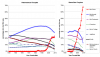
The charts you post are dated. I have the updated chart from the same source, which I have posted here before.
 Social circle
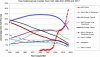
: Fewer heterosexual couples are meeting as a result of their social circles. Meeting people through one's social circle started to decline around 1990, as Boomers were being replaced by Generation X as the main generation of singles. Social circle really took a nosedive around 2000. In 2000-2005, the main groups of singles were late Gen X'ers (1975-1981) and early Millennials (1982-1986). Internet technology affected social circle meetings more than cell phone app technology. Changes in technology in the 2010s did not affect this chart.
Online: It seems to have exploded around 1996-97, with first generation sites like Match, Yahoo Personals, etc and remained strong until around 2004-05. It leveled off about 5-7 years and then exploded with the rise of swipe apps with Tinder's 2012 launch. Instagram launched in 2010, and Facebook purchased it in 2012. Early generation Facebook (2004-2010) was not causing a lot of romantic relationships to form. Instagram has likely been better for relationship formation than Facebook. Same with Twitter.
College: For decades, as more people went to college, more people formed extended romantic relationships from random interactions on campus with the man approaching the woman. Around 2000, as the Millennials were first getting to college, formation of couples in college diminished. I've tracked a lot of my contacts from my college years (early to mid 2000s) over time on social media. Almost no one today from that cohort is with their college era partner. This also coincides with the Millennials having poor social skills and the rise of internet technology, which worsened the social skills of Millennials.
High school sweethearts actually lasting has been in a nosedive since the 1940s. Also, look at the nose dive in workplace related romances since ~1993. Church/religion has been in a nose dive too, starting even before the decline in religious participation.
Bars and Restaurants:This is actually the most interesting set of data points for me.
From 1975-2000, this was quite constant in terms of the percentage of couples forming relationships this way. It has increased since 2000. Why?
What we've seen since 2000 is that as people's college romantic relationships falter somewhere in their mid-20s, they are forced to date again for the first time since college. Many are choosing websites/apps for how they do it, but others have been getting into the bars/other public places for meeting people as they realize that their workplaces cannot serve as a replacement for college socialization for romantic purposes. That last sentence rings especially true for white collar, college educated workers. One does not want to have the feminist HR Manager breathing down your neck over a pickup or relationship gone bad.
Additionally, I believe there's a bit of social desirability bias in the bar and restaurant numbers. Some of the bar/restaurant numbers are people who actually first interacted on websites and swipe apps. People who meet in non-bar venues, such as gyms, grocery stores, on airplanes, etc. are likely lumped in here. I believe that the people forming relationships through non-bar daygame is much smaller than the population randomly meeting at bars.
my opinion: It's OVER for IRL_Cels.
It isn't over for real life approachers. With social circles weakening and swipe apps becoming more challenging, approaching in real life is still a viable tactic. The pandemic is making it more difficult, but outdoor approaching is a still a good method in pandemic era times.